
Latest EUDR updates: EU Commission updates, New Supply Chain Guide, API release, and more
A monthly dose of EUDR news to support your compliance journey


Hello, and welcome to the March edition of our EUDR newsletter!
This month's packed newsletter includes updates from the recent EU Multi-stakeholder Meeting, the new EU supply chain scenarios guide, and myth busters addressing EUDR misconceptions. Plus some bonus Dilify news!
Please do not hesitate to contact us to discuss EUDR in more detail. Click here to book a slot.
If you found this newsletter useful, share it with your colleagues and network by forwarding it to them - all they need to do is click on the subscribe button below to receive it.
At a Glance
#1 EU EUDR Multi-Stakeholder Meeting Updates
#2 EUDR Myth Buster Document Released
#3 Understanding your Company Position
#Bonus API integration to your existing platforms
#1 EU EUDR Multi-Stakeholder Meeting Updates
The European Commission recently provided key updates on EUDR implementation as we move toward the December 30, 2025 compliance deadline.
Several important updates are in progress:
The fourth edition of the FAQs is expected in April 2025, with new content on timeline alignment, export requirements for SMEs, customs representatives, and verification of due diligence
The Commission confirmed that the Implementing Act on country risk benchmarking would be published by June 2025, giving operators six months to adjust their due diligence approaches based on country classifications.
The broader Review process of EUDR's potential expansion continues, with scientific studies and targeted stakeholder consultations underway. A comprehensive all-stakeholder consultation will launch by the end of March 2025. However, the Commission noted that any expansion to other ecosystems, commodities, or the financial sector would be premature.
We will provide a full analysis of the latest FAQs and Country Risk Benchmarking system once both are released.
#2 EUDR Myth Buster Document Released
The European Commission has published a comprehensive "Myth Busters" guide addressing common misconceptions about EUDR and providing clarifications on how the regulation will actually work in practice. This resource aims to correct widespread misunderstandings that have created unnecessary concerns among stakeholders.

Among the key myths debunked in the document:
Myth: "A farmer cannot cut down and sell one of their own trees"
Reality: Farms are generally agricultural land and outside EUDR's scope. When part of a farm is forest, harvesting trees is allowed provided the forest isn't degraded and can regrow. The regulation aims to foster, not hamper, sustainable forestry practices.
Myth: "Every single grain of coffee must be tracked to its origin"
Reality: The regulation allows for aggregated traceability. Companies can report on all sourcing areas collectively when commodities from different plots are combined, assigning all sourcing areas to final products. "Declaring in excess" is permitted when only part of a bulk shipment enters the EU market.
Myth: "EUDR means a mountain of paperwork"
Reality: Due diligence can be submitted electronically through the Information System, with the ability to reuse previously submitted information. The system includes API functionality allowing operators to connect their existing systems directly to the registry.
Myth: "EUDR will harm smallholders in developing countries"
Reality: Legal obligations apply to EU market operators, not to farmers outside the EU. Smallholders' organisations have noted that EUDR could actually strengthen their position in value chains due to the geolocation data they own, potentially leading to fairer prices and new business opportunities.
This guide demonstrates the Commission's commitment to open dialogue and addressing stakeholder concerns.
#3 Understanding your Company Position
The European Commission has released a highly useful new document outlining eleven supply chain scenarios to help companies understand their specific EUDR obligations. This practical guide illustrates exactly how EUDR requirements apply based on your company type (operator/trader), size (SME/non-SME), and position in the value chain.
For example, Scenario 8 provides particularly valuable insights by walking through a complete rubber supply chain from natural rubber imports through to final retail. The scenario examines a case where:
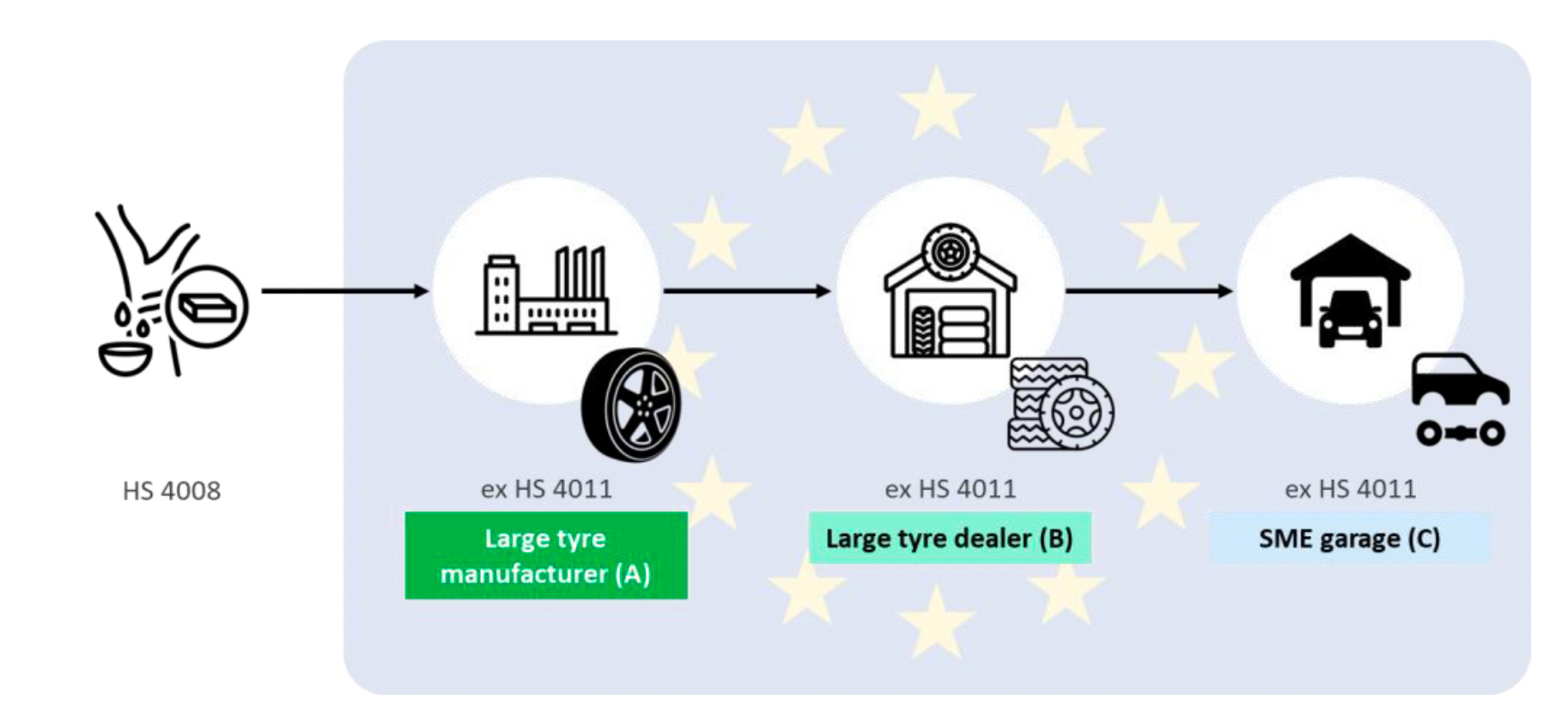
A large EU tyre manufacturer (non-SME) imports natural vulcanized rubber (HS 4008) and must submit due diligence statements as the "first placer" on the EU market
The manufacturer then uses this rubber to produce new tyres (HS 4011), becoming a "downstream operator" and must submit due diligence statements for these new products
A large tyre dealer (non-SME trader) sells these tyres and must verify the manufacturer's due diligence before submitting their own statements while retaining responsibility for compliance
Finally, an SME garage sells the tyres to end customers and, as an SME trader, is exempt from due diligence requirements but must maintain records of suppliers and reference numbers
This resource is intended to complement the existing FAQs and guidance document, providing practical examples rather than replacing the legal text of the regulation. We strongly recommend reviewing the full document, particularly the scenario most relevant to your business, as it offers clear direction on preparing for EUDR compliance by December 2025.
#Bonus API Integration to your ERPs
We're excited to announce the launch of our updated and improved API that provides direct access to EU forest map risk assessments, designed specifically for integration with ERP systems and existing traceability platforms. This powerful capability allows companies to automatically verify polygon compliance against the official EU forest maps for 2020 (the EUDR cut-off date) without leaving their current systems.
This solution is ideal for companies managing large volumes of geolocation data across multiple suppliers and commodities. By integrating forest map verification directly into existing workflows, organisations can dramatically reduce the time and resources needed for EUDR compliance checks.
To learn more about our API integration options, please contact us.